The Devil Rides Out (1968): Christopher Lee Fights for the Light in Hammer’s Occult Masterpiece
Christopher Lee spent much of his career playing the monster. In The Devil Rides Out, Hammer’s 1968 black-magic thriller, he gets to be the man standing between his friends and the forces of darkness, and he counted it among his favorite films. It’s one of Hammer’s best and one of the great occult horror pictures of the sixties.
From Wheatley to Matheson
The film adapts Dennis Wheatley’s 1934 novel, part of his popular series of occult and adventure stories. Lee was a fan of the books and pushed Hammer to adapt them. The screenplay came from Richard Matheson, the American writer behind I Am Legend and many classic Twilight Zone episodes, who trimmed Wheatley’s sprawl into a lean, propulsive story. Terence Fisher, Hammer’s finest director, took the helm. In the United States, the film was released as The Devil’s Bride.
The Duc and His Friends
Lee plays the Duc de Richleau, an aristocrat and scholar of the occult who discovers that the son of an old friend has fallen in with a Satanic circle. With the help of his friend Rex, played by Leon Greene, the Duc sets out to rescue the young man before he’s baptized into the cult. The leader of that cult is Mocata, played by Charles Gray in one of the coolest villain performances of the decade. Gray, later a Bond villain, plays Mocata as a soft-spoken, well-mannered man whose politeness is far more frightening than any snarl.
The Night in the Circle
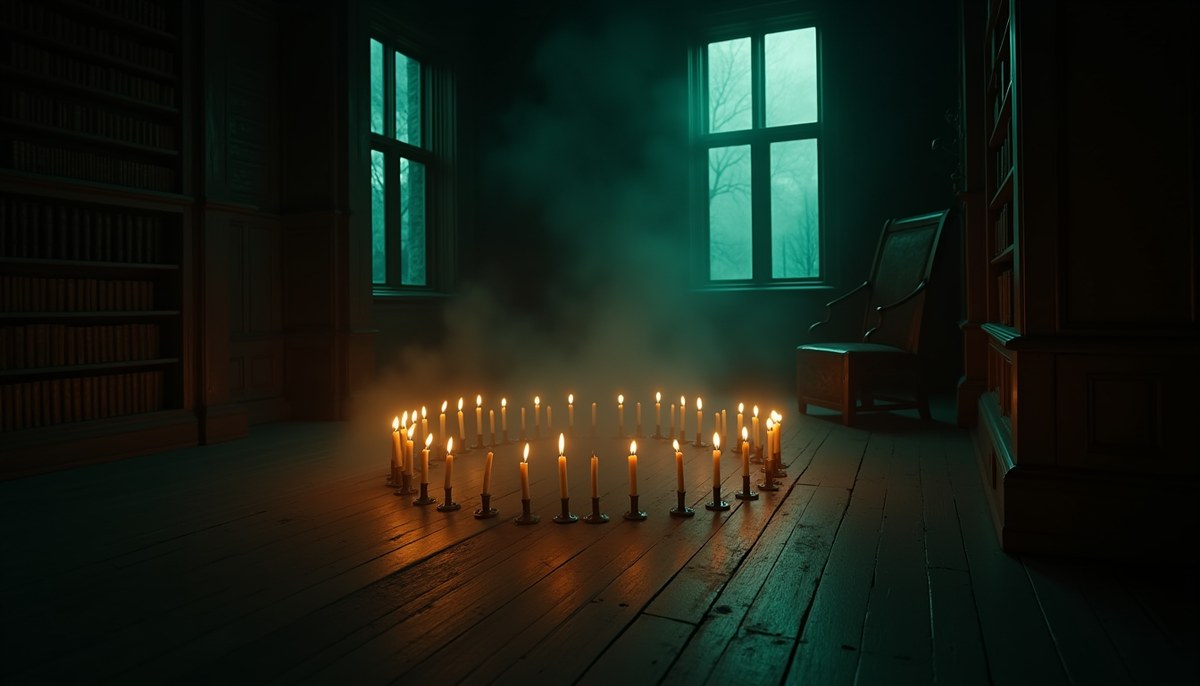
The centerpiece of the film is a long night in which the Duc and his companions shelter inside a chalk circle on the floor of a country house, while Mocata sends horror after horror to break them. It’s a sequence of pure siege horror, with hallucinations, temptations, and a giant spider, all built on the idea that the only defense is to stay inside the line and not lose your nerve. It’s tense, theatrical, and wonderfully staged.
A Few Creaky Effects
Some of the special effects have dated, especially the climactic appearance of the Angel of Death and a few superimposed images. But the film doesn’t depend on them. The goat-headed figure presiding over the woodland Sabbat, lit by firelight and swirling smoke, is still a striking image, and the energy of Fisher’s direction carries the rest.
Hammer’s Moral Universe
Fisher was known for making films where good and evil were real forces, not metaphors, and The Devil Rides Out may be his purest expression of that idea. Faith, friendship, and knowledge are weapons here. That earnestness could feel square in 1968, but today it gives the film a surprising warmth among the decade’s cynical horror.
Christopher Lee’s Favorite
Lee had a long and complicated relationship with Hammer. He grew tired of playing Dracula, often with very little dialogue, and he spoke openly over the years about wanting better material. The Devil Rides Out gave him exactly that: an intelligent, commanding role with real lines, real stakes, and a chance to show his authority and warmth on screen. He later counted it among his favorite of his own films and lobbied for more Wheatley adaptations. Hammer did make one more, To the Devil a Daughter, in 1976, but by then the studio was struggling, and the result was a very different film.
Watching Lee here, it’s easy to see why he was frustrated with the vampire cape. He’s a natural leader on screen, and his crisp delivery of occult lore makes the film’s mythology feel real.
The Sixties Occult Revival
The late 1960s saw a surge of popular interest in the occult, from paperback grimoires to astrology columns, and horror cinema followed. Rosemary’s Baby arrived the same year as The Devil Rides Out, and the decade that followed brought a wave of Satanic panic films. Hammer’s film stands apart for its old-fashioned clarity. It isn’t ambiguous or ironic. It believes the devil is real and that decent people can beat him, and that sincerity makes it stand out from the more cynical films that came after.
The Verdict
If your experience of Hammer is mostly Dracula and Frankenstein, this is the essential next step. It shows the studio at its most ambitious, with a great script, an inspired cast, and Christopher Lee finally getting to fight the darkness instead of embody it. Draw your circle, light your candles, and don’t step outside until dawn.