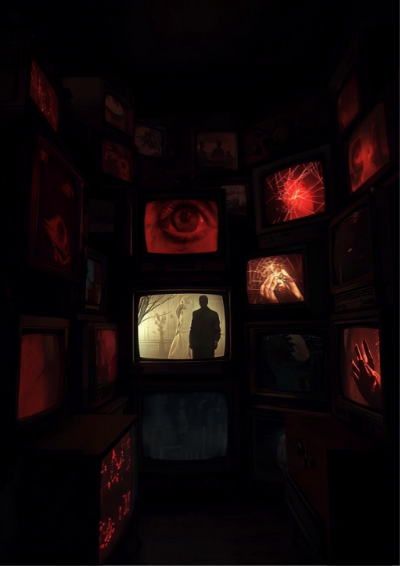
The War of the Worlds at 88: The Night Orson Welles Scared America (Or Did He?)
On the evening of Sunday, October 30, 1938, listeners tuning into CBS heard what sounded like an ordinary evening of dance music. Then came a bulletin. Then another. Explosions observed on Mars. A strange object landed on a farm near Grover’s Mill, New Jersey. A reporter on the scene. Something unscrewing the top of the cylinder. Screams. Then silence. Eighty-eight years later, the Mercury Theatre’s The War of the Worlds is the most famous radio broadcast ever made, and one of the great Halloween stories in American history.
The Mercury Theatre on the Air
Orson Welles was 23 years old and already a celebrated stage director when CBS gave his Mercury Theatre company a weekly radio drama series. They adapted classics: Dracula, Treasure Island, A Tale of Two Cities. For the night before Halloween, they chose H.G. Wells’s 1898 novel about a Martian invasion of England.
Writer Howard Koch, working with producer John Houseman and the Mercury team, moved the action to present-day New Jersey and, crucially, told much of it in the form of breaking news. Koch reportedly picked Grover’s Mill by putting a pencil on a map.
Breaking News From Mars
The genius of the broadcast is its form. The first half is a fake evening of radio: a weather report, an orchestra playing from a hotel ballroom, and then increasingly urgent interruptions. A professor, played by Welles, dismisses the idea of life on Mars. A reporter named Carl Phillips, voiced by Frank Readick, describes the landing site live and is cut off mid-sentence. Troops are sent in. Generals are briefed. The Secretary of the Interior addresses the nation, played by Kenneth Delmar in a voice suspiciously like President Roosevelt’s. Eventually a lone announcer on a New York rooftop describes poison gas drifting across Manhattan, and then he too goes silent.
The second half shifts to a quieter, more traditional narrative, as Welles’s professor wanders a ruined landscape. But by then, the damage was done.
The Panic
The next morning, newspapers across the country reported mass hysteria: people fleeing their homes, jamming phone lines, hiding in cellars. The New York Times ran it on the front page. Welles gave a press conference looking contrite and exhausted. The broadcast became instant legend.
But historians and media researchers have since questioned how big the panic really was. The show aired opposite the hugely popular Chase and Sanborn Hour with ventriloquist Edgar Bergen, and ratings suggest relatively few people were listening to CBS at all. Some listeners who tuned in late were genuinely frightened, and there were real calls to police and newspapers, but scholars have argued that the newspapers, which saw radio as a rival for advertisers and news, had every reason to exaggerate the chaos and paint radio as irresponsible. The truth seems to be that many were alarmed, some were terrified, and most were never fooled at all. The panic itself became a kind of story, and the story kept growing.
What Happened Next
Far from ending his career, the broadcast made Welles famous across the country. The Mercury Theatre got a sponsor, Campbell’s Soup, and before long Welles was on his way to Hollywood, where he made Citizen Kane. The broadcast’s “you are there” style influenced radio and television drama for decades, and it has been rebroadcast, re-recorded and imitated around the world.
Listening Like It’s 1938
To understand why the broadcast felt so real, it helps to remember what radio meant in 1938. It was the fastest news medium in the world. Just months earlier, listeners had heard live, breathless coverage of the Munich crisis in Europe, with programmes repeatedly interrupted by bulletins from abroad. People were primed for interruptions bringing bad news, and the Mercury team knew it. The fake reports borrow the exact rhythms of real wartime radio: the calm studio announcer, the crackling remote feed, the expert who doesn’t quite know what’s happening, the official statement meant to reassure.
The programme did announce that it was a dramatisation at the beginning and during breaks, but anyone who tuned in after the opening, or who stepped out during the announcements, had no context at all. Modern listeners know exactly what’s going on, and it still works on them. That’s the real tribute to Welles, Koch and their cast. Nearly nine decades later, the cylinder still unscrews.
Why We Still Listen
The broadcast still works because it understands how people take in news: in fragments, in real time, from voices they trust. In an era of viral rumours and breaking alerts on our phones, that’s more relevant than ever. It’s also simply a superb piece of radio horror, tight, inventive and properly scary, especially in the dark.
Old-time radio is close to our hearts here at Midnight Macabre. Tonight, on the anniversary, find a recording, turn out the lights, and listen the way people did in 1938. And if the dance music gets interrupted, don’t go looking out the window.