Tenebrae (1982): Dario Argento’s Bright, Brutal Giallo of the Future
By the start of the 1980s Dario Argento had spent several years in the supernatural world of witches and covens with Suspiria and Inferno. With Tenebrae, released in Italy in 1982, he came home to the giallo, the stylish Italian murder mystery he had helped to define a decade earlier. But he did not simply repeat himself. Tenebrae is a giallo drained of shadows, a murder story set in a bright, modern, almost sterile Rome, and it is one of the cleverest and most vicious films he ever made.
A Writer and His Readers
Anthony Franciosa plays Peter Neal, a successful American author of violent mystery novels, who flies to Rome to promote his latest book, also called Tenebrae. Before he even unpacks, a young woman is murdered by a killer who stuffs pages of the novel into her mouth. More killings follow, each one echoing the book, and the murderer starts sending Neal letters. With the help of his assistant Anne, played by Daria Nicolodi, his agent Bullmer, played by John Saxon, and a sceptical police inspector, Neal sets out to find the killer before the killer finds him.
That premise lets Argento do something sly. In the early 1980s his films were being attacked as misogynistic and irresponsibly violent, and Tenebrae puts those very arguments into the mouths of its characters. A journalist accuses Neal of writing sexist trash, and he defends the fantasy of fiction. Argento is having a conversation with his critics through his story, and he does not give either side an easy win.
Even the title is a clue. Tenebrae is Latin for darkness, and it is also the name of an old Holy Week service in which candles are put out one by one until the church is left in shadow. In a film so obsessed with bright light, that is a typically sly joke from Argento.
A Giallo in Daylight
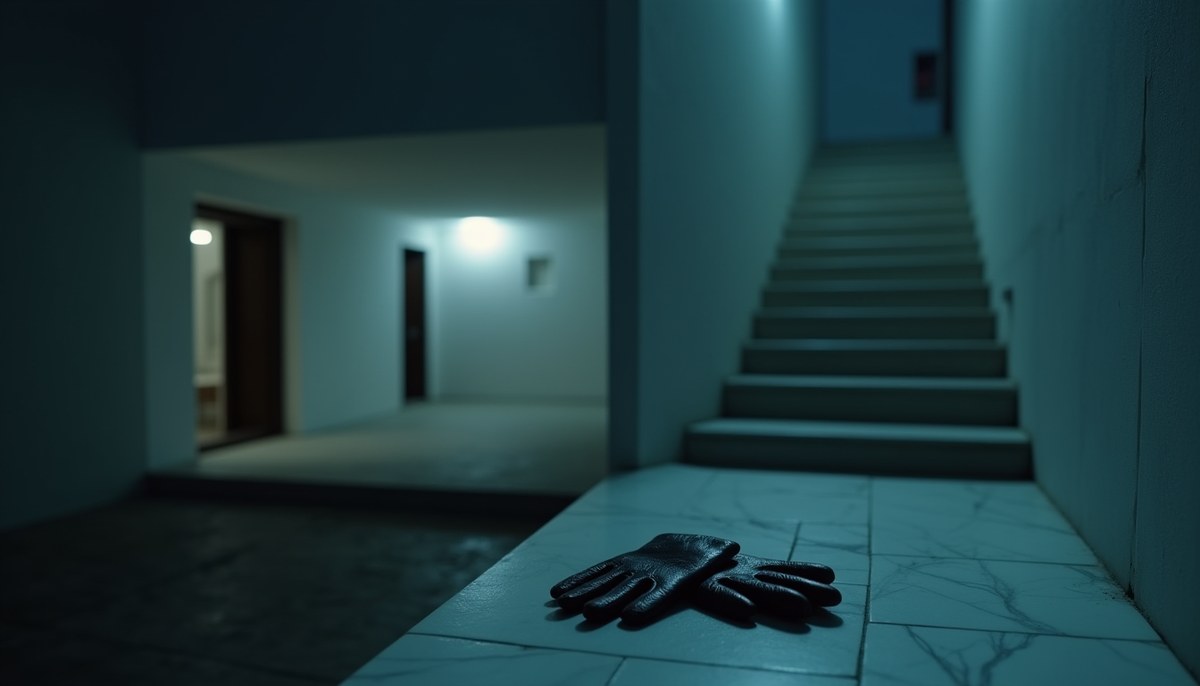
The most striking thing about Tenebrae is how it looks. Argento and his cinematographer Luciano Tovoli deliberately avoided the gothic darkness of the director’s earlier work. The film is full of white walls, glass, concrete and flat, cold light, as though it were set a few years in the future. Even the murders often happen in brightly lit rooms. The effect is unnerving, because there is nowhere to hide, not for the victims and not for the audience.
Tovoli’s camera is restless and inventive. The film’s most famous sequence is a single, astonishing crane shot that climbs up and over the outside of a house, gliding across the roof and down the other side, while the killer prepares to break in. It was achieved with a Louma crane and took days to film, and it still feels like a magic trick.
The Music
The score was composed by Claudio Simonetti, Fabio Pignatelli and Massimo Morante, three members of the band Goblin, who had famously scored Deep Red and Suspiria. Their main theme for Tenebrae is a driving, synthesised piece of early-eighties disco-rock, and it is one of the great horror themes. It is catchy, propulsive and somehow menacing, and it has been sampled and borrowed ever since.
The Kills
This is not a gentle film. The murders are staged with Argento’s usual mix of operatic beauty and cruelty, culminating in a spectacularly bloody sequence involving an axe and a white wall that remains one of the most notorious images in Italian horror. The violence led to the film being caught up in Britain’s “video nasties” panic, when it was placed on the list of titles prosecuted under the Obscene Publications Act. It was later dropped from the list, but its reputation as a shocker stuck.
What makes the violence more than shock, though, is the plotting. Tenebrae is a fiendishly constructed mystery with a twist that many viewers never see coming, and a final scene that is one of Argento’s most audacious. To say more would spoil it.
The Cast
Franciosa is a slightly odd lead, a little too smooth for a man being stalked, but that smoothness turns out to be part of the point. Saxon is enjoyably flashy as the agent, and Nicolodi, Argento’s longtime partner and collaborator, brings warmth to a film that badly needs some. Eva Robins appears in a haunting flashback figure in red shoes, one of the dreamlike images that make the film more than a straightforward whodunit.
The Verdict
Tenebrae is often cited by fans as Argento’s last great giallo, and it is easy to see why. It is formally daring, smartly self-aware, and uncompromising in a way few thrillers of its time were. Its influence can be seen in later films that toy with the line between the creator and the killer.
It belongs right alongside Deep Red on any giallo shelf, and it is a perfect follow-up for anyone who has worked through our Giallo 101 guide. Just be warned: you will be humming that theme for days, and you may never look at a white wall the same way again.