Shock! Theater: How a 1957 TV Package Turned Universal’s Monsters Into Late-Night Kings
Before streaming, before home video, before cable, there was a simple fact of life for American kids: if you wanted to see Dracula, you had to stay up late. And for that, you can thank a television package called Shock! In 1957 it brought Universal’s classic monster movies into living rooms across the country, and in doing so it created the late-night horror host, a generation of “monster kids,” and a whole culture that we at Midnight Macabre still call home.
Fifty-Two Films in a Box
By the mid-1950s, Hollywood studios had a problem and an opportunity. Television was stealing their audiences, but it was also hungry for content, and the studios were sitting on vaults full of old films. In 1957 Screen Gems, the television arm of Columbia Pictures, acquired TV rights to a large library of pre-1948 Universal features. In October of that year it began offering stations a package of 52 of them under the name Shock!
The package was mostly horror: Dracula, Frankenstein, The Mummy, The Invisible Man, The Wolf Man and their many sequels, padded out with a few mysteries and thrillers. A second package, Son of Shock, followed in 1958 with another 20 titles. For a generation that had never seen these films in a cinema, it was like discovering a buried treasure.
The Ratings Monster
Local stations bought the package and, mostly, scheduled the films late at night. The ratings were startling. Contemporary trade reports bragged of huge audience jumps in major cities, and stations quickly realised that a horror movie at 11 p.m. on a Friday or Saturday was a reliable hit. These were films that were twenty years old or more, and they were beating new programming.
The films themselves had something to do with it, of course. Karloff’s monster, Lugosi’s Count and Chaney’s Wolf Man had lost none of their power. But stations soon discovered they could make the experience even better by adding something the cinema never had.
Enter the Host
To give their Shock! broadcasts personality, many stations put a costumed host in front of the camera to introduce each film, crack jokes during the breaks and generally ham it up. The horror host was born, or rather reborn: radio had its sinister narrators, and Vampira had already appeared on Los Angeles television in 1954. But Shock! turned the idea into a nationwide phenomenon.
The most famous of the first wave was John Zacherle, who played a ghoulish character called Roland on Philadelphia television before moving to New York as Zacherley, the “Cool Ghoul.” He would edit himself into the movies, pretend to talk with the monsters, and conduct gruesome experiments on unseen victims in his lab. Up and down the dial, cities got their own hosts, each with a local twist. Many of them became beloved regional celebrities, and some kept going for decades.
Why It Worked
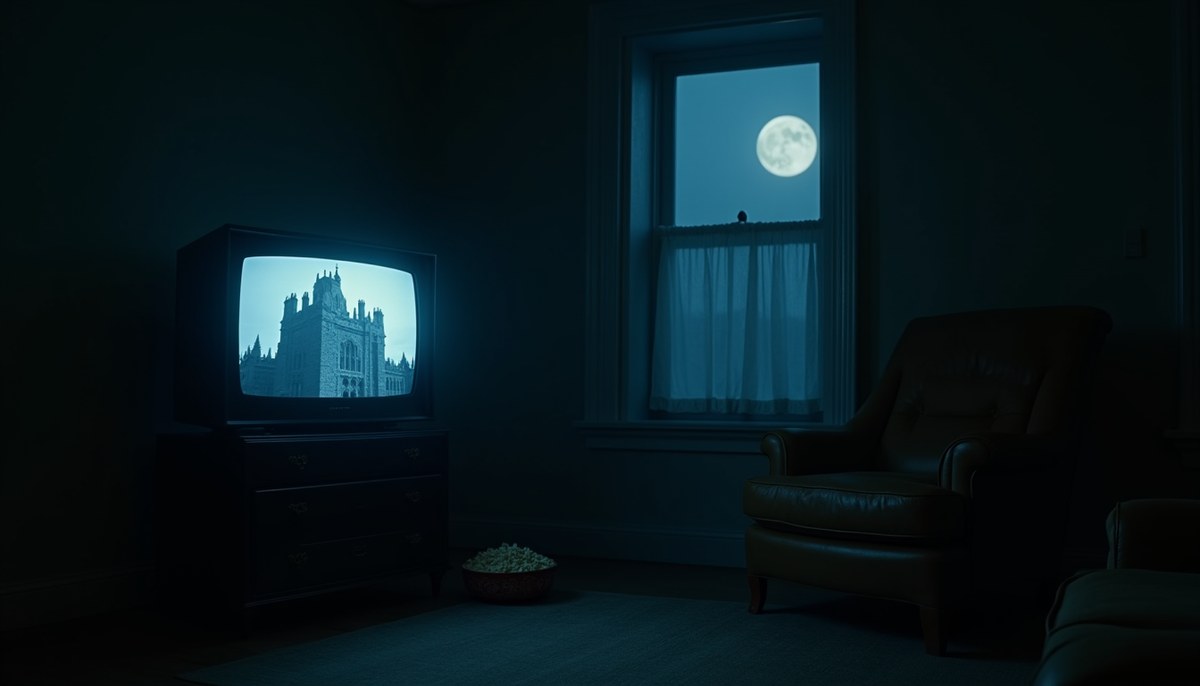
Part of the magic was the setting. A Universal monster movie in a crowded cinema is one experience. The same film, watched in your pyjamas in a dark living room at midnight, with the house creaking around you and a funny ghoul cracking jokes between reels, is something else entirely. It felt forbidden, and it felt personal. The host was talking to you. The monsters were in your house. Families gathered around the set, siblings dared each other to watch, and Monday morning at school was spent comparing notes about who had made it to the end.
The Monster Kids
The audience for all this was often very young. Kids begged to stay up, or crept downstairs after bedtime, to see the monsters. In 1958 Forrest J Ackerman and publisher James Warren launched Famous Monsters of Filmland, a magazine aimed squarely at these fans, full of stills, puns and behind-the-scenes stories. Model kits, toys and records followed. A whole industry grew around kids who had fallen in love with horror through a television screen.
Many of those kids grew up to become the filmmakers, writers, effects artists and critics who shaped horror from the 1970s onward. When you hear a modern director talk about watching monster movies late at night as a child, there is a good chance Shock!, or the creature-feature shows it inspired, is part of the story.
The Legacy on Your Dial
Local horror hosting flourished for decades, through the UHF boom of the 1960s and 1970s and into the cable era with hosts like Elvira. The format is simple and endlessly adaptable: an old movie, a funny ghoul and a sense that you are part of a late-night club that the grown-ups do not quite understand.
That is exactly the spirit we chase here at Midnight Macabre and on WLAI, broadcasting from the edge of the dial. So tonight, on Friday the 13th, turn the lights down and put on one of the old Universal classics. Somewhere in the static, a host is clearing his throat and getting ready to say good evening.