Peeping Tom (1960): The Film That Ended Michael Powell’s Career and Predicted Modern Horror
In the spring of 1960, two films about polite, soft-spoken young men who murder women arrived in cinemas a couple of months apart. One of them, Alfred Hitchcock’s Psycho, became the biggest hit of its director’s career. The other, Michael Powell’s Peeping Tom, was so viciously attacked by British critics that it effectively ended the career of one of the finest filmmakers the country ever produced. Time has been kinder. Peeping Tom now looks like one of the most important horror films ever made, and one of the most uncomfortable.
A Murderer With a Movie Camera
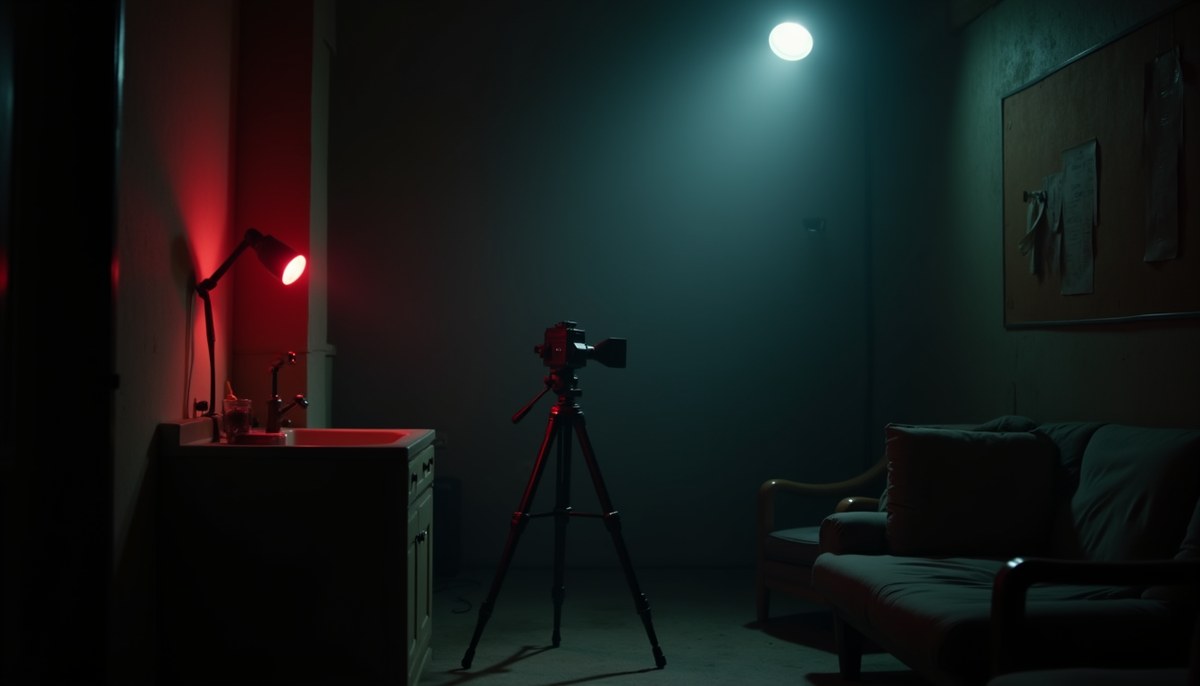
Mark Lewis, played by the gentle-faced German actor Karlheinz Böhm (credited as Carl Boehm), is a focus puller at a London film studio. He is shy, courteous and lonely, and he lives in the house he inherited from his father, renting out the rooms downstairs. In his spare time he photographs pin-ups above a newsagent’s shop. He also kills women, filming their faces as they die, and then screens the footage alone in his darkroom.
The film shows us this in its very first scene, through the viewfinder of his camera. There is no mystery about who the killer is. Powell is not interested in whodunit. He is interested in why, and in what it means that we are watching too.
The Father in the Footage
The screenplay was written by Leo Marks, who had spent the Second World War as a codebreaker, and it gives Mark a monstrous past. His father was a psychologist who used his son as a lifelong experiment in fear, filming the boy’s terror for his research. In one of the film’s most disturbing touches, Powell himself plays the father in the home movies Mark shows, with Powell’s own young son playing the child.
Into this world comes Helen, the kind young woman who lives downstairs, played with real warmth by Anna Massey. She befriends Mark and wants to understand him, and her blind mother, played by Maxine Audley, senses what Helen cannot see. The scenes between Helen and Mark are tender and terrible, because we know exactly what he is and we desperately want her to get out of that house.
Colour, Light and the Act of Looking
Powell had made some of the most ravishing colour films in British history with his partner Emeric Pressburger, including Black Narcissus and The Red Shoes. Red Shoes star Moira Shearer turns up here as a doomed dancer, in a sequence set in an empty film studio after hours that is one of the most beautiful and dreadful in the picture. Peeping Tom uses that colour sense to queasy effect: lurid reds, sickly greens, the glow of a darkroom safelight. It is a gorgeous film about an ugly compulsion, and that tension is the point.
The camera is everywhere. Mark is never without it. People pose for it, perform for it, and die for it. Powell keeps asking the audience the question nobody in 1960 wanted to hear: you paid to watch someone be frightened, so what makes you so different from him?
The Backlash
British critics in 1960 answered that question by attacking the man who asked it. Reviews were overwhelmingly hostile, some of them startlingly personal, and the film was pulled from release. Powell, who had been one of Britain’s most celebrated directors, found it almost impossible to get financing at home afterwards. He made a few more films, mostly abroad, but his career never recovered.
Why the fury, when Psycho was embraced a few months later? Part of it was timing and part of it was class: Hitchcock was a popular entertainer, while Powell was a prestige artist who was supposed to know better. But mostly, Peeping Tom refused the escape hatch. Psycho lets you blame Norman Bates. Peeping Tom keeps turning the camera back on the audience.
Resurrection
The film’s reputation was rebuilt slowly, by people who saw what the critics had missed. Martin Scorsese championed it and helped bring it back to American screens around 1979, and a new generation of critics and filmmakers began to treat it as a masterpiece. Powell lived long enough to see the turnaround, which is more than many reviled artists get.
Watch it now and you can trace a direct line to the slasher films of the 1970s and 1980s, to found footage, and to every horror movie that makes us complicit in what we are seeing. It is a film about cinema itself, and about the dark pleasure we take in other people’s fear.
The Verdict
Peeping Tom is not an easy watch, and it is not meant to be. It is elegant, sad, deeply creepy and decades ahead of its time. If you only know Psycho, make this its double bill. Then sit for a moment in the dark afterwards and think about why you pressed play. That is exactly what Michael Powell wanted, and it cost him everything.