The Haunting (1963): Robert Wise’s Ghost Story Where You Never See the Ghost
There’s a moment in The Haunting when two women huddle together in a bedroom while something pounds on the walls outside, moving from door to door, testing each one. Then the pounding stops, and the ornate wooden door begins to bulge inward, as if the house itself were breathing. Nothing comes through. Nothing ever comes through. And it’s one of the most frightening scenes in film history.
From Hill House to the Screen
Shirley Jackson’s novel The Haunting of Hill House was published in 1959 and quickly recognised as a classic, with its famous opening line about Hill House “not sane.” Director Robert Wise came across the book, loved it, and brought it to MGM. Screenwriter Nelson Gidding adapted it, and in 1963 the film arrived, shot in black and white in England, with the exteriors filmed at Ettington Park, a Victorian Gothic mansion in Warwickshire.
Wise is best remembered for West Side Story and The Sound of Music, but he started out as an editor and director in Val Lewton’s horror unit at RKO, directing The Body Snatcher with Boris Karloff. Lewton’s great lesson, that what you imagine is worse than anything you can be shown, is the foundation of The Haunting.
Eleanor
The story follows Dr. John Markway, an anthropologist played by Richard Johnson, who invites a small group to stay at Hill House to study its reputation. Joining him are Theodora, a sophisticated psychic played by Claire Bloom; Luke, the cynical heir to the house, played by Russ Tamblyn; and Eleanor Lance, played by Julie Harris.
Eleanor is the film’s heart and its victim. A lonely woman who spent years caring for her invalid mother, she arrives at Hill House starved for belonging, and the house seems to welcome her. Harris plays her with raw nerves and heartbreaking hope, and much of the film is narrated through her anxious inner voice. The terror of The Haunting is partly supernatural and partly the slow realisation that Eleanor wants to stay.
A House That Watches
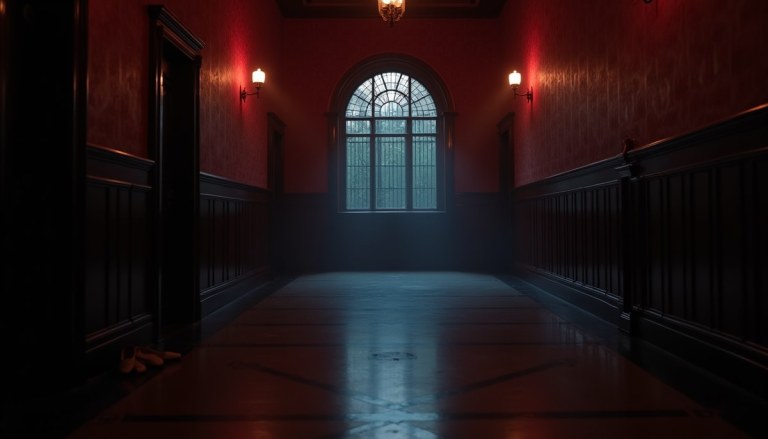
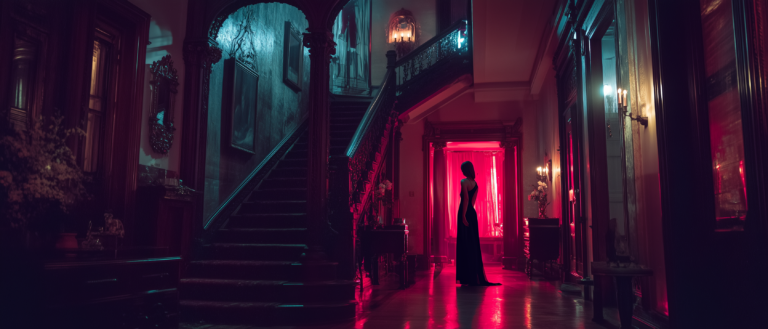
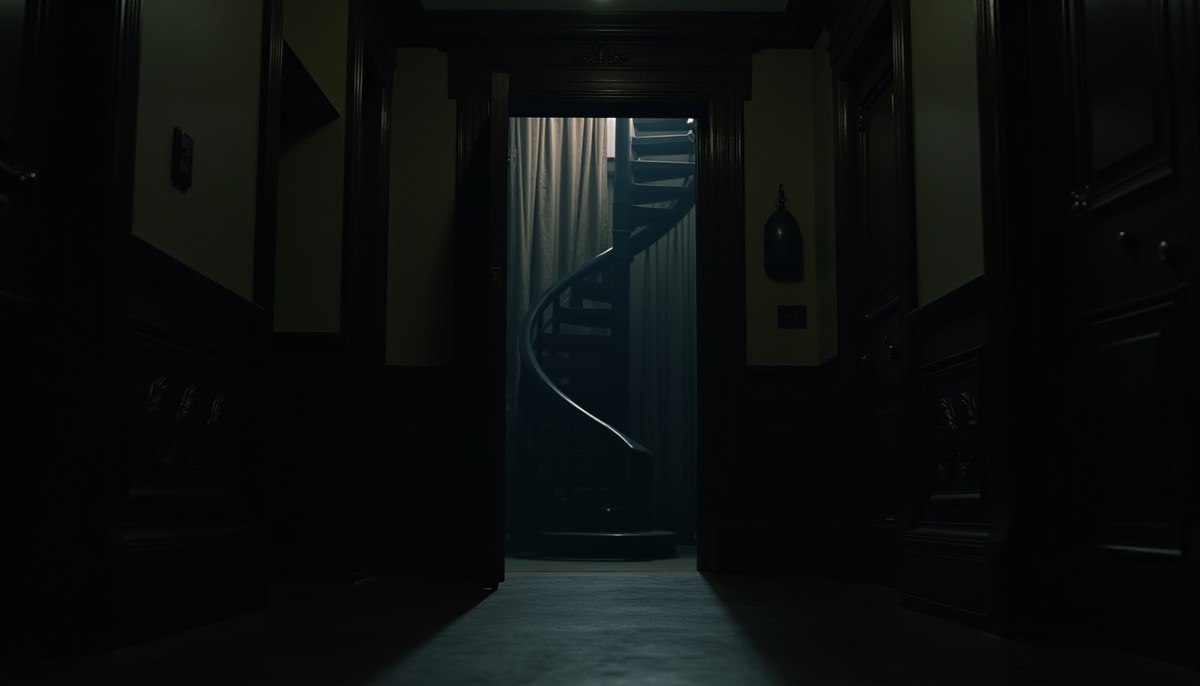
Wise and cinematographer Davis Boulton made Hill House itself the monster. The interiors, designed by Elliot Scott, are cluttered, carved, mirrored and deliberately disorienting, with rooms that don’t sit at right angles. Wise shot much of it with a wide anamorphic lens that distorts the edges of the frame, so the walls and ceilings seem to curve and lean. The camera prowls, tilts and swoops up the iron spiral staircase in the library. Faces in the carvings seem to stare. Even in daylight, the house feels like it’s paying attention.
Sound as a Weapon
Then there’s the sound. The pounding in the hallways, the giggling and moaning, the voice that seems to whisper behind the walls. Humphrey Searle’s score is used sparingly, leaving the house’s noises to do the work. The most famous moment comes in the dark, when Eleanor clutches what she assumes is Theodora’s hand while listening to a child crying somewhere in the house. When the lights come up, Theodora is across the room. “Whose hand was I holding?” Eleanor asks. It’s a line that has chilled audiences for over sixty years.
What Came After
A 1999 remake went all-in on computer effects and is mostly remembered as a cautionary tale. In 2018, Mike Flanagan’s Netflix series The Haunting of Hill House reimagined the story with great success. But the 1963 film remains the purest version of the idea: a haunted house movie that refuses to cheat. It’s routinely cited by filmmakers, including Martin Scorsese, as one of the scariest films ever made.
Theodora and Eleanor
One of the most quietly radical things about The Haunting is Theodora. Claire Bloom plays her as a confident, sharp-tongued woman who is clearly drawn to Eleanor, and the film, working within the limits of 1963, makes no secret of it. Their relationship is the most complex in the movie: affectionate, teasing, jealous and finally cruel, as Theo watches Eleanor fall for the married Dr. Markway. Jackson’s novel hinted at the same dynamic, and Wise and Gidding kept it.
That tension matters because it isolates Eleanor further. Every human connection she reaches for slips away, and the only thing that seems to truly want her is the house itself. By the time Mrs. Markway arrives, unannounced and skeptical, and disappears into the nursery, the film has become as much a tragedy about loneliness as a ghost story. That’s what makes the final scenes so haunting. You understand exactly why Eleanor would choose Hill House, and that’s the most frightening part of all.
Why It Endures
The Haunting works because it trusts its audience. It gives you a door, a sound and a lonely woman’s fears, and lets your imagination build the ghost. No special effect has ever topped that.
It’s the kind of film the late-night hosts loved to save for the darkest part of the night, and it’s a permanent fixture on the Midnight Macabre shelf. Watch it alone. Hold your own hand.